 good roots
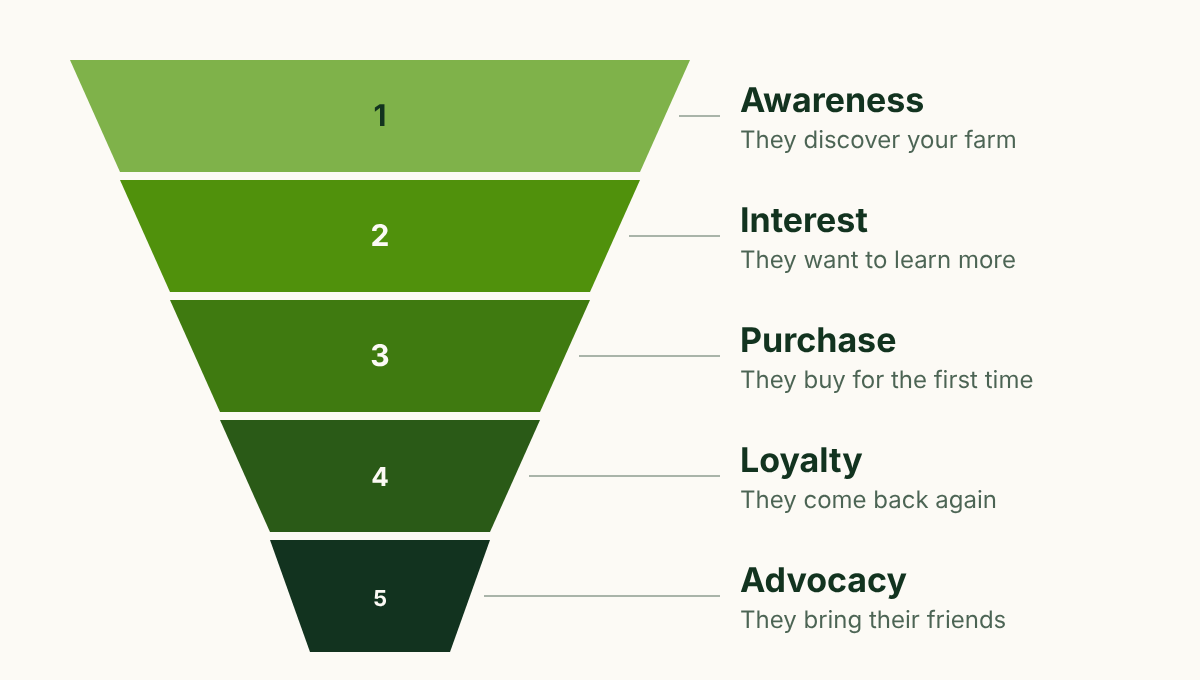
As a farmer or food entrepreneur, you already know you need more customers. What’s harder to see is how someone goes from never having heard of you to buying from you every week. The marketing funnel is a simple way to picture that journey, so you can see where people drop off and where a little effort pays off most.
In this guide, we’ll walk through each stage of the funnel and show how it applies to a farm or food business, whether you sell at markets, through a CSA, online, or wholesale.
What Is a Marketing Funnel?
A marketing funnel shows the stages a customer moves through on the way to buying from you. It’s wide at the top, where lots of people first notice your business, and narrow at the bottom, where a smaller group becomes loyal, repeat customers.
Not everyone who hears about your farm will buy, and that’s normal. The goal isn’t to get every person through. It’s to understand each stage well enough to move more of the right people to the next one.
Stage 1: Awareness
At the top of the funnel is awareness: the moment a potential customer first discovers your farm or food business. They don’t know much about you yet. They’ve just noticed you exist.
For farmers and food entrepreneurs, awareness might come from:
- Your booth at the farmers market, or signage at your farm stand
- Social media posts that show your farm, your products, and the people behind them
- A local news story, a podcast, or a feature in a regional food guide
- Your listing on Google, so you show up when someone searches for local meat, eggs, or produce
- Word of mouth, retail shelf placement, or a restaurant that names your farm on its menu
At this stage, a strong, recognizable brand does a lot of the work. People can only come back to a business they remember. Our guide to essential branding for farms and food brands covers the basics.
Stage 2: Interest
Once someone knows you exist, the next step is getting them curious enough to learn more. This is where you give people a reason to stay in touch before they’re ready to buy.
An email list is one of the most valuable tools at this stage. Unlike social media, you own it, and your message lands directly in someone’s inbox. Make signing up easy by featuring a simple form on your website and social media, and in person at farmers markets and events. A clipboard or QR code at your booth works.
Other ways to build interest:
- Samples and tastings that let people try before they commit
- Website content that answers their questions, like how your animals are raised or how a CSA share works
- Behind-the-scenes posts and stories that build a connection with your farm
Not sure what to send once people sign up? Try these 10 fresh email newsletter prompts, and save time with a newsletter template.
Stage 3: Purchase
This is where interest turns into a sale. Your job at this stage is to make buying as easy as possible and to remove anything that makes people hesitate.
- Make prices, pickup locations, and delivery options clear and easy to find
- Accept the payment methods your customers actually use, at the market and online
- Keep your online store simple, with as few steps to check out as possible
- Give people a clear next step, like “Reserve your CSA share” or “Order for Saturday pickup”
If you sell online, the platform you choose matters. See our breakdown of the best ecommerce platforms for farms and specialty food brands.
Stage 4: Loyalty
The marketing funnel doesn’t end after a purchase. Keeping a customer you already have usually costs far less than finding a new one, and repeat customers are the backbone of most farm and food businesses.
Ways to build loyalty:
- Follow up after a first purchase with a thank-you, a recipe, or storage tips
- Offer subscriptions, CSA renewals, or standing orders so buying again is automatic
- Reward repeat customers with early access to seasonal products or limited cuts
- Stay in touch through the off-season so they don’t forget you before next year
Be careful with discounts. They can bring people back, but they can also train customers to wait for a sale and eat into your margin. Here are some alternatives to discounting that build loyalty without cutting your price.
Stage 5: Advocacy
The final stage of the marketing funnel is advocacy, where your most loyal customers become your best marketers. People trust recommendations from friends and neighbors more than any ad, and advocates bring new customers back to the top of the funnel.
Encourage advocacy by:
- Asking happy customers for reviews on Google or your website
- Collecting testimonials you can use in your marketing
- Starting a simple referral program, like a credit for every friend who signs up
- Sharing photos and posts from customers who tag your farm
Learn why customer testimonials are as good as gold, and four ways to get them.
The Marketing Funnel in Action
Here’s how the funnel might look for a small vegetable farm selling CSA shares.
A shopper stops at the farm’s market booth because the display catches their eye (awareness). They taste a sample, chat with the farmer, and scan a QR code to join the email list (interest). Over the next few weeks, the newsletter shares what’s in season and how the CSA works. When signups open, a clear email with a single “Reserve your share” button makes it easy to commit (purchase). Through the season, weekly emails with recipes and farm updates keep them engaged, and an early-renewal offer brings them back next year (loyalty). By the second season, they’re telling coworkers about their CSA and leaving a review online (advocacy).
Each stage depends on the one before it. A farm with great market traffic but no way to capture emails loses most of those people at stage two. A farm with a big email list but a confusing sign-up process loses them at stage three.
How to Find Where Your Funnel Is Leaking
You don’t need complicated software to start. Pick one or two simple numbers for each stage and check them regularly:
- Awareness: market foot traffic, website visitors, social media reach
- Interest: new email signups, email open rates
- Purchase: new customers, online orders, CSA signups
- Loyalty: repeat purchase rate, CSA or subscription renewal rate
- Advocacy: new reviews, referrals, customers who say a friend sent them
Where the numbers drop off sharply is where to focus first. And keep an eye on margins as you grow: marketing that brings in customers at a loss doesn’t build a business. As we like to say, no margin, no mission.
Need Help With Your Marketing Funnel?
Good Roots helps farm and food businesses build marketing that’s tied to their numbers, from brand and website to email and ads. See how our marketing team works, or book a free 20-minute call and we’ll show you where your funnel is leaking.